
Why Your AC Runs All Day but the House Still Feels Humid
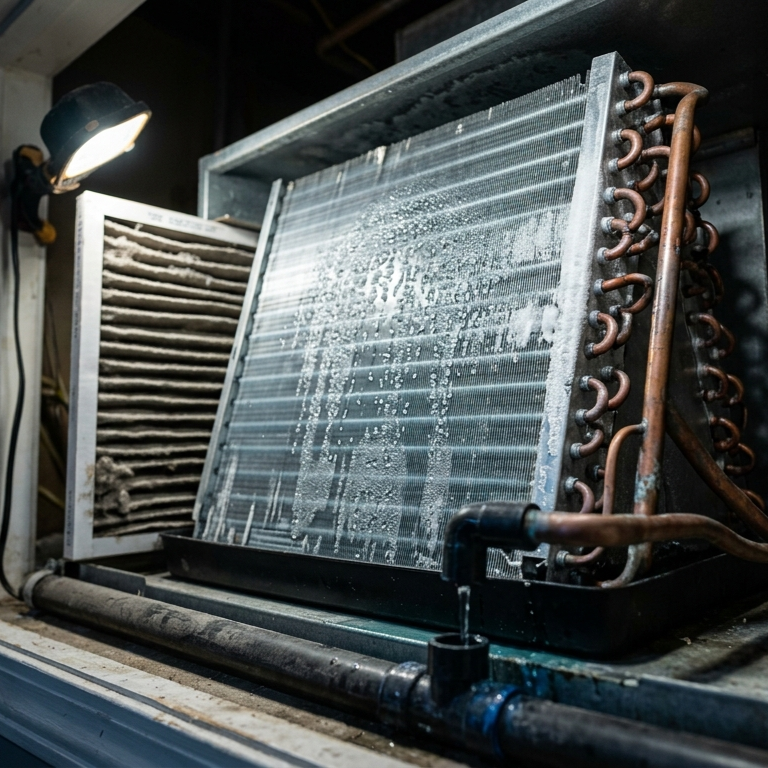
Quick Answer: Your AC pulls moisture from the air only while it runs long, steady cycles — the cold coil has to stay cold long enough to wring water out. If the unit is oversized, low on refrigerant, fighting a dirty or frozen coil, or has its fan set to ON, it cools the air without drying it. The EPA's target is to keep indoor humidity below 60% and ideally between 30% and 50%; above that, a cold house still feels like a wet towel.
The thermostat says 74, the AC has been running since lunch, and the air still feels like you could wring it out. Doors stick, the bathroom mirror won't clear, and there's that clammy heaviness no amount of cold air seems to cut. Damp air slows how fast sweat evaporates off your skin, so a humid room feels warmer than its temperature reading — which is why "cold but sticky" is so miserable. In a place like Tampa, where the outdoor air is soaked most of the year, an air conditioner that cools but doesn't dehumidify isn't doing half its job. The reason almost always traces back to how long and how cold the system runs.
How Cooling and Drying Are Two Different Jobs
An air conditioner dries your home almost as a side effect. Warm, humid indoor air gets pulled across the evaporator coil — the cold coil inside your air handler — and because cooler air can't hold as much moisture, water condenses on the coil the way it beads on a glass of iced tea. That water drips into a pan and runs out through the condensate drain. The home gets cooler and drier at once.
But there's a catch built into the physics: condensation only occurs once the coil has been cold for a while and the air has had time to pass over it. Cooling the air is quick. Drying it is slow. A system that satisfies the thermostat in short bursts pulls the temperature down without ever giving the coil time to do the moisture work. That gap — fast cooling, slow drying — is the root of almost every "cold but sticky" complaint.
Match the Symptom to the Cause
Before assuming the worst, line up what you're noticing with what tends to cause it. This is a quick way to tell the difference between a thermostat setting and a refrigerant problem.
| What you're noticing | Likely cause | Where it points |
|---|---|---|
| Cools fast, shuts off quick, still humid | Oversized unit short-cycling | System sizing / runtime |
| Air feels weak and humidity creeps up | Frozen or dirty evaporator coil | Airflow / coil service |
| Never quite cools, runs nonstop, humid | Low refrigerant charge | Refrigerant leak check |
| Humid only when the system idles | Fan set to ON instead of AUTO | Thermostat setting |
| Sticky in some rooms, water near the unit | Leaky return ducts or a clogged drain | Duct / condensate service |
The Oversized Air Conditioner That Cools Too Fast
It sounds backward, but a unit that's too big for the house is one of the most common reasons a home stays humid. An oversized system blasts the rooms to temperature in a few minutes, hits the setpoint, and shuts off — before the coil has spent enough time condensing moisture out of the air. The temperature drifts up, it kicks on for another short blast, and the cycle repeats. That's short-cycling.
The result is a house that's cold and damp at once. A cooling cycle needs a sustained run — on the order of fifteen minutes or more — to actually wring water out; an oversized unit cuts off well before that. This is why right-sizing equipment to the home (a load calculation, not a rule of thumb) matters more in a humid climate than almost anywhere, and why proper AC sizing on installation is worth insisting on. Variable-speed and two-stage systems help for the same reason: they run longer at low output, which dehumidifies far better than an oversized unit that blasts and stops. If your system already cycles on and off constantly, that pattern itself is worth diagnosing.
When the Coil Is Frozen or Filthy
The evaporator coil can only pull moisture from air that flows across it freely. Choke that airflow — with a clogged filter, a dirty coil, or a failing blower — and two things happen. First, less air gets dried. Second, the coil can get so cold that condensation freezes into a layer of ice, which insulates the coil and shuts the drying process down almost completely. People sometimes notice weak airflow and assume the unit is just tired, when it's actually iced over behind the panel.
A dirty coil does a slower version of the same thing. A film of dust and grime acts like a blanket between the air and the cold metal, so moisture that should condense on the coil sails past instead. Changing the filter on schedule and keeping the coil clean — the heart of a routine tune-up — is the cheapest humidity fix there is, and the first thing to rule out.
The Refrigerant, Thermostat, and Ductwork Traps
If the system runs almost constantly and still can't get comfortable, the refrigerant charge may be low, usually from a leak. Refrigerant is what makes the coil cold; short it, and the coil never reaches the temperature where serious condensation happens. The unit runs and runs, sips moisture at best, and your bill climbs while the air stays heavy. Low refrigerant is a repair, not a setting, and it needs a technician to find the leak rather than just top it off.
The thermostat trap is the easiest to fix and the easiest to miss. If your fan is set to ON, the blower runs even when the system isn't cooling. Here's the mechanism: when cooling stops, water is still sitting on the coil waiting to drain. A fan that keeps blowing pushes that moisture right back off the coil and into your rooms — re-humidifying the house you just dried. Switch the fan to AUTO so it only runs during cooling cycles.
Ductwork is the trap you can't see. Return ducts running through a hot attic or crawlspace, if they leak, pull humid unconditioned air straight into the system and distribute it through the house, which is why one room can stay muggy while another is fine. And if the condensate drain clogs or the pan overflows, the moisture the coil pulled out has nowhere to go and backs up instead of leaving the home.
Set the thermostat fan to AUTO, not ON. On ON, the blower re-evaporates the water sitting on the coil between cooling cycles and sends it back into the house — one wrong setting can undo the system's dehumidifying entirely.
Why This Hits Harder Along the Gulf Coast
Tampa sits in a humid subtropical climate, and morning relative humidity here runs in the 80s for much of the year. That heavy, constant moisture load is exactly why oversizing and short-cycling cause so much trouble locally: a unit that cools too fast leaves a humid-climate home damp, while the same unit in a dry region would feel fine. The same load is why clogged condensate drains and sweating, mildew-prone ducts are common headaches — there's simply more water moving through the system every day. An older system that has lost some of its moisture-removal capacity will struggle here long before it fails outright.
When cooling alone can't keep up, a whole-home dehumidifier tied into the system handles humidity directly rather than relying on the cooling cycle. In a climate this wet, that pairing — part of a broader indoor-air-quality setup — is often what finally makes a house feel dry rather than just cold.
Frequently Asked Questions
The EPA recommends keeping indoor relative humidity below 60 percent, and ideally between 30 and 50 percent. Above 60 percent, the air feels sticky, and the conditions for mold and dust mites improve. A simple hygrometer lets you see where you actually stand instead of guessing.
Yes, and it's a frequent problem. An oversized unit cools the space so fast that it shuts off before it can pull moisture from the air, leaving the home cold and damp. Bigger is not better with cooling equipment — a right-sized system that runs longer, steadier cycles dehumidifies far better than an oversized one that blasts and stops.
That's the classic sign of a thermostat fan set to ON. The blower keeps running between cooling cycles, blowing the water still sitting on the coil back into your rooms before it can drain. Switching the fan to AUTO usually clears it up, because the fan then runs only while the system is actively cooling and condensing moisture.
It can. A clogged filter starves the coil of airflow, which means less air gets dried and, in bad cases, the coil freezes over and stops dehumidifying altogether. A frozen coil also reduces airflow, so a damp house with weak vents is worth checking for a filter before anything else.
Often, yes. A whole-home dehumidifier removes moisture directly, so the AC doesn't have to run extra-long cooling cycles just to manage humidity. In a wet climate where the moisture load is heavy year-round, that pairing is frequently what makes a home feel properly dry.
Because cooling and dehumidifying aren't the same job. A system that's oversized, short-cycling, running with a dirty coil or low refrigerant, or moving air too fast can lower the temperature without pulling out enough moisture — so the house feels cold and clammy. In Tampa's humidity, proper sizing, airflow, and sometimes a dedicated dehumidifier are what actually dry the air.
Comfort Is Temperature and Moisture Together
A home that runs the AC all day and still feels muggy is telling you the system is winning on temperature but losing on moisture. The fixes range from simple — a clean filter, sealed ducts, the right fan speed — to a properly sized system or an added dehumidifier for Tampa's heavy humidity. Get both temperature and moisture under control, and the house finally feels cool and dry instead of cold and damp.
AC running all day but the house still feels humid? — Get your system's sizing, airflow, and dehumidification checked so your home feels dry. CMB Air serves Tampa and the Tampa Bay area. Call (813) 447-1443.
