
Why Your AC Freezes Up in the Middle of Summer
The Coil That Shouldn't Be Cold Enough to Freeze
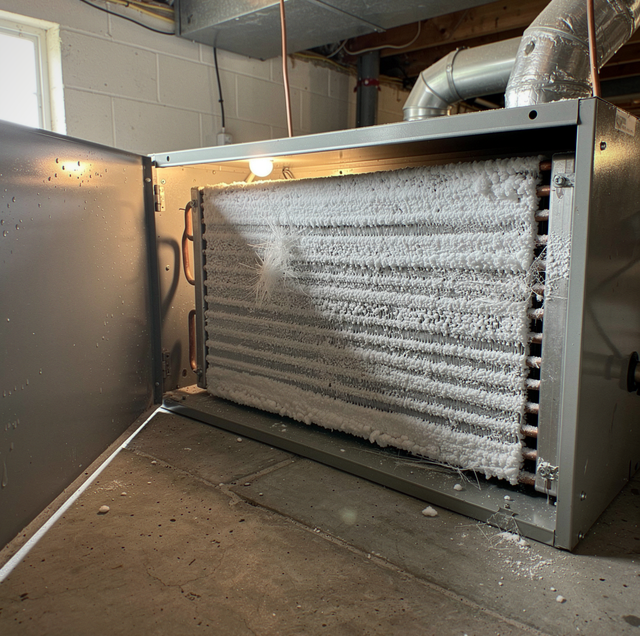
Ice on an air conditioner in July looks wrong the moment you see it. The unit is straining against ninety-plus-degree heat, the compressor is running almost nonstop, and somehow a layer of frost is creeping across the refrigerant lines or building into a solid block on the indoor coil. It seems backward: more heat should mean a lower chance of ice, not a higher one. A frozen coil in peak summer isn't really about outdoor temperature at all. It's about what's happening to the refrigerant inside the coil, and that process can go wrong regardless of how hot it is outside.
The Refrigeration Cycle Depends on a Specific Coil Temperature
An air conditioner cools a house by moving heat, not by generating cold. Refrigerant flows through the indoor evaporator coil at low pressure and absorbs heat from the air blown across it by the blower fan. That heat transfer depends on the coil staying within a fairly tight range, typically somewhere in the high thirties to low forties Fahrenheit: cold enough to pull heat and humidity out of the air, but not so cold that it drops below freezing.
When everything works as it should, warm household air moves across the coil quickly enough that it never gets colder than that range. The moment airflow slows down or refrigerant pressure inside the coil drops for mechanical reasons, the coil temperature can fall below 32 degrees. Once that happens, moisture that's always present in indoor air starts condensing and freezing directly onto the coil's surface instead of draining away as water. That first thin layer of frost insulates the coil from the air passing over it, which lowers the temperature further and accelerates the buildup. It's a feedback loop: a little ice makes it easier to grow a lot of ice, and a system beginning to freeze rarely fixes itself.
Low Refrigerant Is the Most Common Cause
A system running low on refrigerant, whether from a slow leak in a coil, a fitting, or a line, can't maintain the correct pressure inside the evaporator coil. Lower pressure lets the remaining refrigerant boil off at a lower temperature than it's supposed to, which drops the coil surface below freezing even though the compressor is doing exactly what it was told to do. This cause isn't really about airflow at all, and it's also the one most likely to keep coming back after a quick fix, since the system won't hold a full charge until the source of the leak is found and sealed.
A telling sign of a refrigerant-related freeze is that it tends to develop gradually over days or weeks as the charge slowly leaks away, rather than appearing suddenly after one hard afternoon. The house may also have felt less effective at cooling for a while before the ice appeared, since a system running low on refrigerant loses cooling capacity before it starts freezing.
Restricted Airflow Is the Other Major Cause
Anything that keeps enough warm air from reaching the coil has the same end result as low refrigerant: the coil gets colder than it should. Airflow restriction is arguably the more common culprit in peak summer, mostly because it's tied to factors that worsen with heavy runtime.
A dirty air filter: A filter clogged with dust and pet hair chokes off return air before it reaches the blower. In peak summer, when a system might run for eighteen or twenty hours a day instead of cycling a few times, a filter merely dirty in June can go fully blocked by August.
Closed or blocked supply vents: Furniture pushed in front of a floor register, a vent closed to redirect airflow, or a return grille blocked by a rug all reduce the air volume the blower can pull through the system, starving the coil while the compressor keeps running at full pressure.
A failing or undersized blower: A weakening motor, a slipping belt, or a blower wheel caked in dust can't move the air volume the coil was designed around, even with a clean filter and open vents.
A dirty evaporator coil: Dust and grime on the coil's fins acts like a second filter that was never meant to be there, blocking airflow at the exact point where it matters most.
A Thermostat Set Too Low Can Push a Marginal System Over the Edge
A system borderline on airflow or refrigerant charge might run for years without freezing, right up until someone sets the thermostat several degrees colder than normal, chasing extra comfort during a heat wave. Longer, harder runtime keeps the coil at its lowest temperature for more hours at a stretch, giving a marginal issue more time to tip the coil below freezing. The thermostat setting alone rarely causes a freeze in an otherwise sound system, but it's often the trigger that turns a borderline problem into a visible one.
Why Running the System to Melt the Ice Out Usually Backfires
Once ice is visible, the instinct is to let the AC keep running, reasoning the compressor will work through it. That instinct is backward. The compressor is designed to pump refrigerant vapor, not liquid. When the coil is frozen, refrigerant passing through it can't fully absorb heat and change into vapor before heading back toward the compressor. Some of it can return as liquid instead, and a compressor that ingests liquid refrigerant, a condition technicians call slugging, can suffer serious internal damage within minutes, since liquid doesn't compress the way vapor does.
Continuing to run the system also lets the ice accumulate rather than shrink. A block of ice around the coil and lines only grows the longer refrigerant keeps flowing at freezing temperatures. The correct response is to switch the system off, not run it through the problem.
What to Do the Moment You Notice Ice
Switching the thermostat off, or setting the fan to run continuously while the compressor cycle stops, cuts the refrigerant flow feeding the ice and lets the blower keep pushing room-temperature air across the coil, which speeds the thaw considerably compared to leaving everything off. A fully iced coil can take several hours to melt clear this way, and there's no safe way to speed that along with a hair dryer, hot water, or a scraper without risking the thin aluminum fins or copper tubing underneath.
While the ice melts, check the filter, since that's the fastest thing to rule out and the most common cause. A filter that's visibly gray or matted is worth replacing on the spot regardless of whether it turns out to be the whole story. Walk the house and confirm supply vents aren't blocked by furniture and the return grille has clear airflow. If the filter is clean, the vents are open, and ice still returns within a day or two after thawing and restarting, the problem is more likely a refrigerant leak or a mechanical airflow restriction that requires gauges and an inspection inside the cabinet to diagnose.
Telling a Refrigerant Problem Apart From an Airflow Problem
The two causes look similar once ice has formed, but they tend to develop differently and call for different responses.
| Clue | Points Toward |
|---|---|
| Ice built up gradually over days or weeks; cooling felt weaker beforehand | Refrigerant leak |
| Ice appeared suddenly after one heavy-runtime day; filter turns out dirty or vents blocked | Airflow restriction |
| Ice clears after thawing and a filter change, then returns within a day or two | Refrigerant leak (or unresolved blockage) |
| Ice clears after thawing and a filter change, and stays clear for weeks | Airflow restriction, resolved |
| Hissing or bubbling sound near the indoor unit or lines | Refrigerant leak |
| House also has one persistently hotter room or weak airflow at several vents | Airflow restriction, often duct-related |
A refrigerant leak requires locating and sealing the leak point, then recovering and recharging the system to the manufacturer's specified charge, work that requires EPA-certified handling of refrigerant and a licensed technician's tools and training. An airflow restriction, once identified, is often resolved by changing the filter, clearing blocked vents, cleaning the coil, or replacing a failing blower motor. Both problems produce the same symptom: a frozen coil, which is exactly why the underlying cause matters more than the ice itself.
When the Freeze Points to a Bigger Issue
A frozen coil that keeps recurring after the obvious fixes- filter changed, vents opened, ice fully thawed- and it still freezes again within a week or two, usually means something more than a one-time cause. A refrigerant leak that hasn't been found yet will keep dropping the charge no matter how many times the system gets topped off. A blower motor slowly failing will keep losing airflow capacity even after a fresh filter goes in. A system nearing the end of its service life may also freeze more readily simply because worn components no longer hold the tight tolerances the refrigeration cycle depends on. At that point, a technician checking refrigerant pressures against the manufacturer's specifications and testing airflow across the coil directly is a faster path to an answer than repeating the same thaw-and-restart cycle every few days for the rest of the season.
Frequently Asked Questions
Yes, and the risk shows up faster than most people expect. Liquid refrigerant returning to the compressor during a freeze, even a light one caught within the first hour, can wash lubricating oil off the compressor's internal bearings, causing wear that isn't visible until the compressor starts failing weeks or months later.
It varies widely by cause. A significantly blocked filter combined with a thermostat set several degrees low can freeze a coil in as little as two to four hours of continuous runtime, while a slow refrigerant leak might take several days or weeks of normal operation before the charge drops low enough to trigger ice.
Some light frost on the refrigerant lines near the outdoor unit can accompany a freeze that started at the indoor coil, since the same low-pressure refrigerant traveling back to the compressor runs through those lines. Frost specifically on the outdoor coil is less common and usually points to a defrost-related issue in a heat pump system rather than a standard air conditioner problem.
Yes. A sensor reading several degrees warmer than the actual room temperature keeps signaling the system to run past the point it should shut off, extending runtime well beyond what the space needs and creating the same prolonged-runtime conditions a manually low setting does.
It can, if the system's blower wasn't sized for the added resistance. A higher-MERV filter is denser and restricts airflow more than a standard one, and swapping to one without checking whether the existing blower can still pull enough air through it can push a marginal system into freezing territory during the highest-runtime weeks of the season.
The outdoor unit doesn't need to be covered, but the whole system, indoor and outdoor together, should be switched off at the thermostat during the thaw, since the compressor and outdoor fan only run when the indoor coil is calling for refrigerant flow.
A frozen coil in the hottest stretch of summer is a mechanical signal, not a random malfunction, and it's telling you something specific about airflow or the refrigerant charge rather than the outside heat. Reading that signal correctly and giving the system a full thaw before restarting it keeps a fixable filter or airflow problem from turning into a compressor replacement.
Schedule an AC diagnostic — get the refrigerant charge and airflow checked before a recurring freeze turns into compressor damage. CMB Air serves Tampa and the Tampa Bay area. Call (813) 447-1443.
