
Ductless Mini-Split vs. Window Units for a Garage or Addition
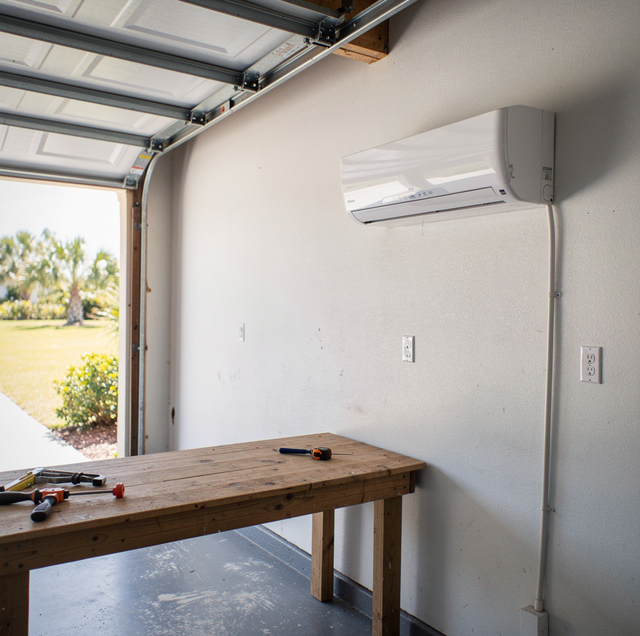
A converted garage or a bonus-room addition rarely connects to the main duct system the way the rest of the house does, so it needs its own cooling source. The two realistic options are a window or through-the-wall unit set into an opening, or a ductless mini-split with a small head mounted inside and the compressor set outside. Both can cool the space. Which one actually belongs there depends on how the room gets used, what shape it's in, and whether the answer needs to work in January as well as July.
Where the Compressor Lives Changes Everything Else
A window unit is a single sealed box that does all its work in the wall opening: the compressor, the condenser coil, and the fan that dumps heat outside are all crammed into the same housing as the evaporator coil, which blows air into the room. That compressor is the loudest, hottest-running part of the whole machine, and in a window unit it sits a few feet from wherever you're standing.
A mini-split splits that job in two. The compressor and condenser live outside on a pad or wall bracket, connected by a thin refrigerant line set to a wall-mounted head indoors that does nothing but move air across a coil and blow it into the room. The indoor half has no compressor running, so it operates at a fraction of the noise level. In a garage used as a workshop, gym, or home office, that difference is not a comfort preference; it's the difference between a space you can hold a phone call in and one you can't. A table saw already competes with the compressor noise of a window unit for attention; it shouldn't have to.
Capacity That Holds a Setpoint Instead of Chasing It
Most window units run one speed: full blast until the thermostat is satisfied, then off. A mini-split built around an inverter-driven compressor modulates its output instead, ramping up on a hot afternoon and settling into a low, steady hum once the room is close to setpoint. That behavior shows up as moisture removal more than as temperature, and it's the strongest technical difference between the two.
Cooling and dehumidifying are two separate processes that share the same coil. Moisture leaves the air only when it spends enough time moving across a cold coil to condense and drip into a drain. Single-speed operation by itself isn't the culprit: a single-speed unit matched to its load runs long cycles and dries a room perfectly well. The failure mode is short runtime relative to load, which is what oversizing produces. A unit that satisfies the thermostat in a few minutes has done the cooling job and skipped most of the drying, which is why a window unit can bring a garage down to a cool number on the display and still leave the air clammy.
A second mechanism is specific to window units, and it gives back work the machine already did. Most of them let you leave the indoor fan running continuously while the compressor cycles off. With the compressor off, the coil warms toward room temperature and the water condensed on it during the last cycle evaporates straight back into the air the fan is still pushing across it. Setting the fan to cycle with the compressor stops that. An inverter mini-split avoids both problems by design: long, low cycles instead of short hard ones, and an indoor fan that tracks what the coil is doing.
The Uninsulated Garage Is a Bigger Load Than Either Machine Expects
Before comparing the two machines, the room itself deserves a hard look. An uninsulated garage door radiates heat directly off the sun-baked steel; a bare slab soaks up heat from the air and from a hot car parked on it and gives it back through the evening; and gaps around the door track let outside air leak in continuously. That combination can put a greater cooling load on a garage than on a bedroom twice its size, and it keeps doing that whichever machine is installed.
Weatherstrip the door track, add rigid foam board to the door panels, and seal gaps around conduit or vents before sizing equipment. Insulating first can drop the required capacity enough to change which machine makes sense.
Sizing to an unimproved garage tempts a buyer toward the biggest unit available, on either side of this comparison, and a big unit sized for an uninsulated shell short-cycles the same way an oversized central system does once the door gets weatherstripped or a car stops parking with the engine still hot. Insulate the door and slab first, get an honest load number for the improved space, and the choice between a modest window unit and a small mini-split head gets a lot easier.
Heating Decides the Year-Round Question
A mini-split built as a heat pump runs its refrigerant cycle in reverse to pull heat from the outside air and deliver it indoors, the same principle a central heat pump uses, just scaled to one room. Most window units either skip heating entirely or include only a resistance strip, which converts electricity to heat one-for-one and thus delivers roughly a third of what a heat pump moves indoors on the same power. In a garage or addition used only for a few warm months, that gap doesn't matter much. In a space used as a year-round workshop, home gym, or guest suite, it's often the deciding factor: one machine handles both seasons with a single outdoor unit, and the other needs a space heater to stand in for half the year.
What Actually Goes Into the Wall
The two installations ask for very different levels of work. A window unit needs an opening it fits, a way to seal the gaps around its cabinet, and a dedicated receptacle nearby, which for a garage-size unit usually means a proper circuit rather than sharing an outlet with power tools. Mounting it is mostly a heavy, awkward lift and a careful seal, which is part of its appeal.
One detail gets missed at this step: a standard window unit draws condenser air through louvers on its sides and back, so it isn't interchangeable with a through-the-wall unit. A wall sleeve blocks those side intakes, starving the condenser. Through-the-wall models are designed to vent only from the rear.
Never run a window unit from an extension cord. Its compressor draws high startup current, and a cord not rated for that load can overheat within its insulation before the breaker trips. Give the unit its own receptacle.
The wall opening a window unit sits in doubles as the easiest point of entry on a garage or a ground-floor addition. A unit that isn't properly secured in its frame can be pushed or pried from outside, and even a well-fitted one still leaves a gap around its cabinet that a storm can drive rain through. A mini-split's outdoor compressor sits on a pad or bracket, and the indoor head is a sealed unit on an interior wall, so neither one interrupts the building envelope the way a box wedged into an opening does.
A mini-split asks for more. A technician runs a refrigerant line set and control wiring through a small wall penetration, mounts the outdoor unit on a pad or bracket, and wires a dedicated circuit sized for the compressor. Then there's the part people forget until it's a problem: the indoor head has to shed condensate somewhere. Where the line set can run to an exterior wall with a slight downhill pitch, gravity carries the condensate outside on its own. Where the head has to sit somewhere a straight, sloped run isn't possible, a small condensate pump lifts the water to a drain point instead, and that single constraint often decides where a head can go on the wall more than aesthetics do. Either way, this is refrigerant and electrical work behind a wall, not a DIY afternoon, and it belongs to a licensed technician.
Lifespan Comes Down to What Wears and What Gets Serviced
Neither machine lasts forever, but the two wear differently. A window unit's compressor, coil, and fan motor all share a single cabinet exposed to whatever weather reaches that wall, and when a part fails, the whole sealed unit is usually replaced rather than repaired, typically within 8 to 10 years of regular use. A mini-split's outdoor compressor faces the same weather exposure a central AC condenser does, but the indoor head runs in a conditioned space, and its filters are easy to reach and clean, which tends to stretch service life closer to twelve to fifteen years with routine maintenance. Both numbers depend heavily on how consistently filters get cleaned and coils get checked.
Matching the Machine to the Space
A garage or addition used seasonally, for light-duty tasks, where noise and moisture removal aren't critical, is where a window unit earns its place with a simpler, more contained installation. A space used year-round, for anything where quiet matters, or anywhere humidity control actually has to hold through a long season, is where a mini-split earns its place instead. An uninsulated shell changes the sizing conversation for either machine, and heating needs are often the single factor that settles it. The honest answer depends on the room in front of you.
Frequently Asked Questions
It depends on insulation and use. A well-sealed, insulated two-car garage can often be handled by a single appropriately sized head, while an uninsulated shell with a steel door may need either a larger unit or insulation improvements first; a technician sizing the space with a load calculation, not square footage alone, gives an accurate answer.
Not off the stickers. Window units are rated with EER or CEER, measured under a single fixed set of conditions, while mini-splits carry SEER2, a seasonal average derived from a range of conditions and part-load operation. The two numbers come from different tests, so a higher figure on one label doesn't make a machine better than a lower figure on the other.
Not without help. A condensate pump handles that situation, and most run on a small integrated float switch that shuts the head down or trips an alarm if the reservoir isn't draining, which is a deliberate safeguard against water backing up into the wall rather than a nuisance feature. It needs occasional cleaning to keep that float free, since a stuck float is a common reason a mini-split shuts itself off in humid weather.
A properly installed unit on its own dedicated circuit, secured in its frame, is designed for continuous operation. A garage-size unit typically draws enough current to need its own 15- or 20-amp circuit, and sharing that circuit with a refrigerator, freezer, or power tools is enough to trip a breaker even without an extension cord in the picture.
A window unit's compressor and fan sit a few feet away in the same cabinet doing the cooling, typically in the 55 to 65 decibel range on high. A mini-split's indoor head has no compressor at all, just a fan across a coil, and commonly runs closer to 25 to 40 decibels, a difference easily noticeable in a room used for concentration or sleep.
A window unit's physical mounting can often be handled without a technician, but the dedicated circuit it needs is electrical work. A mini-split requires a licensed technician for the refrigerant line set, the electrical connection, and the condensate path, and, on many models, keeping the equipment warranty valid requires a signed record of that professional installation and refrigerant charge check.
Choosing between these two machines is really a decision about the room: what it's insulated to, what it's used for, and whether it needs to work in the cold months as well as the hot ones. Get an honest read on the space before the equipment gets picked, and the right answer tends to be obvious.
Get a load assessment for your garage or addition before you buy — a technician can tell you whether a mini-split or a window unit actually fits the space. CMB Air serves Tampa and the Tampa Bay area. Call (813) 447-1443.
