
Cover or Shut Off Your AC Before a Storm? One Backfires
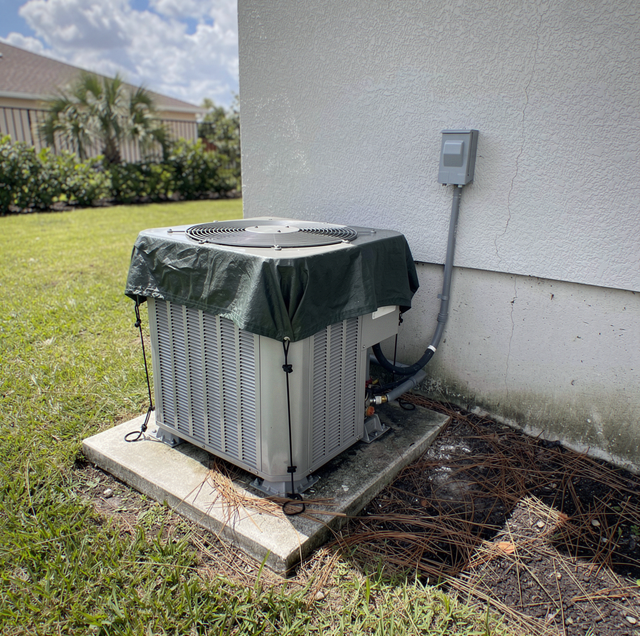
An outdoor condenser has an open top with a fan pulling air up through it, a coil face on the sides, and drain holes in the base pan. Two things a storm sends at that arrangement matter: solid material dropping through the top opening, and whatever arrives on the wire feeding the unit. The first is answered by something over the cabinet for a few hours. The second is answered by an open breaker, and it is the half that gets left undone.
The Cover Comes Out Before the Rain Does
The tarp comes out of the garage the night before, still creased from the last time, and goes over the condenser with a bungee cord under the base rail on each side. Or it is a fitted vinyl cover cinched with a drawstring around the bottom of the cabinet. Either way, the unit stops looking like something the weather can get at.
Those two habits point in opposite directions. A cover earns its place against material falling onto the unit, for the few hours that material is in the air, while a full wrap that seals the cabinet does more damage than the rain it keeps out. Cutting power earns its place before any storm that could take the grid down, because everything that reaches a condenser without touching it arrives on the service wire. In practice, the cover gets the careful work, and the breaker gets none of it.
A Condenser Is Built to Stand in the Rain
Your outdoor unit spends its whole service life outside, and every part of it is picked for that. The cabinet is painted steel with drain openings in the base pan, so rain entering through the top grille runs out the bottom. The coil is aluminum fin wrapped around a copper tube, and rain falling through it rinses it. The electrical connections sit behind a gasketed panel. Wind-driven rain is the condition that the cabinet was built around.
A full wrap changes that cabinet in three ways, and each works against the equipment.
It stops air from moving through the fins, so a coil that got wet stays wet. Overnight, the temperature drops, moisture condenses on the inside face of the cover and runs back onto the aluminum. Corrosion needs a wet metal surface and oxygen, and a surface that never dries between rains supplies both. A cover pulled down past the base rail also seals the pan's drain openings, so any water that gets in stays.
It also makes the cabinet worth moving into. A dark, dry, sheltered box is a good place to build a nest, and the softest material in there is the insulation on the low-voltage control wiring.
If the system runs with the cover on, it fails in a hurry. A condenser sheds heat by pulling outdoor air across the coil and pushing it out the top. Block that path while the compressor is working and the high-side refrigerant has nowhere to dump its heat, so head pressure climbs until the high-pressure switch opens or the compressor pulls enough current to trip its internal overload. Either way, the unit shuts down under strain, and one afternoon with a forgotten cover on is enough to do it.
Falling Debris Is the One Hazard a Cover Answers
Set the water aside, and the case for a cover gets stronger, though narrower than it looks. Fin stock on a residential coil is aluminum a few thousandths of an inch thick, folded into a wall of narrow passages. A driveway pebble, roof granules, a length of screen frame, or a small branch bends that stock flat where it lands, and a flattened fin restricts airflow there until someone combs it straight again. The fan opening on top is the only face of the cabinet with nothing across it, and if a limb or a handful of gutter debris drops into it, it reaches the coil, the fan blade, and the motor at once.
That is the hazard a cover answers: material arriving from above. It is a shield against what falls, not a jacket against weather, and the specification follows. A cover for falling material only needs to be on while that material is in the air, which is hours, and it has to come off afterward. It sits over the top and the upper cabinet with the lower sides left open, so air keeps moving through the fins and a wet coil can dry, which is also why mesh beats a solid sheet. A rigid panel weighted over the top stops more of what falls than fabric will. Whatever holds it down has to hold in real wind, because a cover that lets go becomes debris itself and can drag a hook through the coil as it passes.
Cutting Power Is the Half That Gets Skipped
Everything that reaches a condenser during a storm without touching it comes down the service wire, and it arrives in three shapes.
Restoration is the one people have felt. When a utility re-energizes a circuit after an outage, the return can overshoot the nominal 208 to 240 volts and may come and go several times in a minute while crews section the line. Equipment left connected takes whatever the return delivers, and a contactor that closes on that return hands it straight to the compressor.
A spike is faster than anything in the system can react to. It does its damage in a fraction of a thousandth of a second, shorter than a breaker needs to sense an overcurrent or a contactor needs to open. The only thing standing between a spike and a control board is the board not being connected to the wire upon arrival.
Sagging voltage gets the least attention. During a grid disturbance, line voltage can drop well below nominal while still being present. A compressor asked to start on it draws more current to make the same torque, and if it cannot come up to speed, it sits at locked-rotor current, several times its running draw, until the internal overload opens on heat. The overload cools, closes, and the motor tries again. Every attempt puts heat into the windings, and the thermostat upstairs has no idea it is happening.
De-energizing removes the unit from all three. With the circuit open, there is nothing at the contactor to close, no board reading a signal, and no way for the compressor to attempt a start on voltage nobody is measuring. That is the whole benefit. The cost is a walk to the panel and back, and on a unit with a crankcase heater it is also a restart that cannot be hurried.
On a unit with a crankcase heater, energize that heater for up to 24 hours before the first compressor start, so refrigerant that migrated into the oil while power was off boils back out.
The Disconnect and the Breaker Do Different Jobs
Turning the thermostat off is the shutdown people assume they have already done. It stops the call for cooling; the contactor drops open; the compressor and outdoor fan stop; and 240 volts remains on the line side of that contactor the entire time. Nothing is running, and nothing is de-energized.
The pull-out box mounted on the wall within sight of the condenser goes a step further. Pulling its handle opens the circuit at the unit, which is what a technician does before opening a service panel. What the handle does not open is the wire feeding the box: the line-side terminals inside stay energized from the house panel, which makes the box a fair-weather device. Pulling it while standing in water, or during an active electrical storm, puts you in the fault path with nothing upstream of you switched off.
The breaker in the electrical panel is the switch that de-energizes the branch circuit itself, wire and all, from the panel out to the disconnect. That is the one to use for a storm shutdown. The indoor air handler is on its own breaker, so a full shutdown requires opening two breakers.
Timing decides whether any of this is a homeowner job. Do it early, while the weather is dry and the ground around the equipment is dry. Once the storm is on top of the house, leave the outdoor box alone and work from the indoor panel. And the decision stops being yours entirely at standing water on the pad or at the panel, or a downed line anywhere on the property. Past that point, every switch stays put, and the utility and a licensed electrician take it from there.
Securing the Unit Without Moving It
The condenser is tied to the house by a brazed copper line set and a flexible electrical whip. Neither is strong enough to hold the cabinet in wind, and both are easy to damage by shoving the unit around. Relocating it to a garage means cutting refrigerant lines and recovering the charge, which is a service call in its own right.
What keeps a condenser where it belongs is the connection between its base rail and the pad. Manufacturers put hold-down holes in that rail for anchoring hardware, which loads the frame as it was built to be loaded. Straps thrown over the top of the cabinet bear instead on the coil face and the fan grille, the two parts least able to take a point load. Whether your unit has to be anchored at all, and to what standard, is a question for the local building authority.
The rest of the work happens away from the equipment. What hits a condenser in a storm came out of the yard it sits in: a patio chair, a grill, a planter, a trash can lid, a fence panel leaning against the shed. Clearing what is unsecured within throwing distance of the pad does more for your coil than any cover will, and so does cutting back limbs that overhang it. One thing to skip is stacking sandbags against the cabinet, which blocks airflow at the coil face and holds wet sand against painted steel for days after the water is gone.
Frequently Asked Questions
Rain alone is doing very little to that coil. What a cover stops is impact, and with no wind there is nothing overhead getting knocked loose to fall on the unit. Worth knowing for the windy case: grit driven by wind arrives horizontally rather than from above, so a cover shaped to shed what falls will not keep grit out of the fins, and that damage gets handled afterward by washing the coil face down. Rain without debris in the air leaves the coil better off uncovered and free to dry.
Both. The air handler runs on its own breaker, and in a system with electric heat strips, that circuit carries the largest single load in the house. The sequencer that stages those strips is a control component like any other, and it sits on the line as long as the breaker is closed. Killing the outdoor breaker alone leaves that half of the system connected.
Early enough that you are throwing a dry breaker in a dry space, which means well before the wind picks up rather than during it. One thing worth doing first: run the house a few degrees cooler for an hour or two before you shut down. Once the compressor stops, the indoor coil stops pulling moisture from the air, and indoor humidity climbs within hours whether or not the power ever goes out.
It is a poor trade. Running means the outdoor fan is pulling air through the coil at full velocity, so anything crossing the yard is drawn into the fins harder than it would strike a unit sitting still. The fan blade is a light aluminum or composite propeller, and gusts against a spinning blade load the motor bearings in a direction they are not built for.
The shutdown is simpler, and the reasoning is the same. When the indoor heads are fed through the outdoor unit rather than from their own branch circuits, opening that unit's breaker de-energizes the heads along with the compressor. The wiring diagram inside the outdoor service cover tells you whether yours is wired that way. Check, too, whether the install has a disconnect at all; some do not, making the panel breaker the only shutoff.
None of it happens at all if the pad or the panel stood in water, or if you cannot say whether it did; the breaker stays open until someone qualified has looked at the unit. Otherwise: pull any cover off, set the thermostat to off so the system cannot call for cooling the instant the circuit closes, then close the breaker and seat the disconnect. Closing the breaker starts a crankcase heater's clock, and on a unit that has one, the compressor start waits for the period the heater needs. Without one, the wait is short because the control board runs an anti-short-cycle timer for about five minutes after power returns.
A pre-storm AC check takes the disconnect, contactor, and condenser anchoring off your own list — all three looked at before the next system moves through. CMB Air serves Tampa and the Tampa Bay area. Call (813) 447-1443.
