
What MERV Rating Should Your Air Filter Be? A Quick Guide
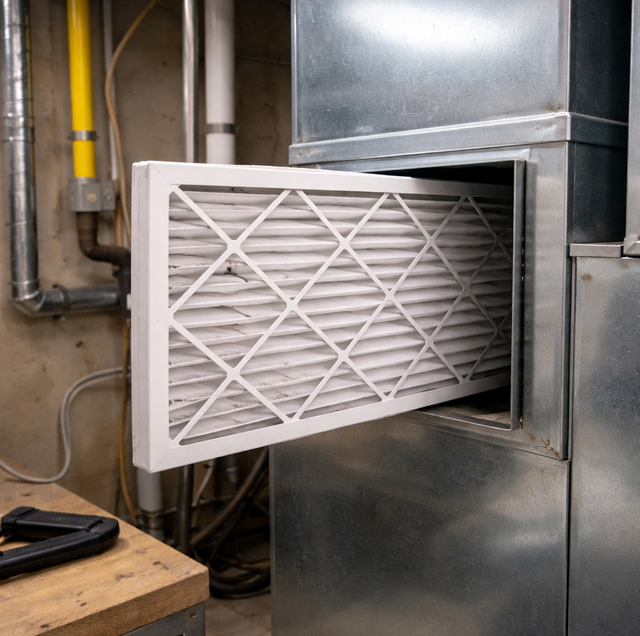
Quick Answer: Most residential HVAC systems run well on a filter rated between MERV 8 and MERV 13. Higher ratings capture finer particles but resist airflow more, so confirm your system can handle a denser filter before jumping to the top of the scale.
Standing in the filter aisle with numbers running from 1 to 16 is a small ordeal, especially when the packaging insists that bigger is better. It usually is not that simple. The number stamped on an air filter tells you how much it catches, but it says nothing about whether your particular blower can pull air through it without a fight. Buying the finest filter on the shelf can backfire on a system that was never built to breathe through it.
Before any recommendation makes sense, it helps to know what that number actually measures.
What MERV Actually Measures
MERV stands for Minimum Efficiency Reporting Value, a standardized rating set by the ASHRAE 52.2 test method. It scores how effectively a filter captures airborne particles across a range of sizes, from coarse debris down to particles a fraction of the width of a human hair. The residential scale runs from about 1 to 16. A higher number means the filter traps a larger percentage of smaller particles.
The keyword is minimum. A MERV rating reflects the filter's worst-case capture efficiency during testing, not a best-case marketing figure, which is part of why the scale is useful for comparing products fairly. It measures capture, though, not airflow. Two filters with the same rating can restrict a blower differently depending on their pleat depth and media, and that gap between what a filter catches and what it costs you in airflow is the whole reason MERV selection takes a little thought.
The MERV Scale, Range by Range
Each band of the scale corresponds to a particle size the filter reliably captures. Reading the ranges makes the tradeoffs concrete.
MERV 1 to 4: Basic protection: These flat fiberglass panels catch large particles like lint, carpet fibers, and the coarsest dust. They protect the equipment more than the air you breathe. Airflow passes through them easily, which is their main virtue.
MERV 5 to 8: Everyday household air: This range captures common household dust, most pollen, and mold spores. A MERV 8 pleated filter is a common factory-friendly choice because it balances reasonable filtration against low resistance.
MERV 9 to 12: Finer dust and pet dander: Filters here trap finer dust, pet dander, and smaller pollen fragments. Households with shedding animals or mild allergies often land in this band because the jump in capture is noticeable without heavily loading the system.
MERV 13 to 16: Smoke, bacteria, and very fine particles: The top of the residential scale reaches into very fine particles, including some smoke, bacteria-carrying droplets, and combustion soot. MERV 13 is frequently cited as a practical target for better indoor air quality, and it is often the highest a typical home system should attempt without modification.
The Airflow Tradeoff Nobody Mentions
A denser filter is a finer net, and a finer net is harder to pull air through. Every step up the scale adds resistance, measured as static pressure, and your blower has to work against that pressure to move the same volume of air.
Air moving through a filter behaves a bit like water through a kitchen strainer. Swap a colander for a fine-mesh sieve and the same pour slows to a trickle. In an HVAC system, that slowdown is not harmless. Restricted airflow can force the blower motor to labor, reduce heating and cooling efficiency, and starve the indoor coil of the warm return air it needs. On a cooling system, a starved coil can drop below freezing and ice over, which stops cold air entirely until it thaws.
This is a year-round concern rather than a seasonal one. In cooling months, a choked filter can freeze the coil; in heating months, the same restriction makes a furnace cycle harder and can trip its high-limit safety. The filter that is too dense for your equipment causes trouble whatever the weather outside.
Why Most Homes Land Around MERV 8 to 13
Most residential systems are engineered with a modest amount of static pressure headroom, enough to run a moderately efficient filter without strain. That is why the MERV 8 to 13 window fits most homes. It delivers meaningful filtration while staying inside what a standard blower can comfortably handle.
Going higher is not automatically better for your air. If a MERV 15 filter restricts airflow so much that the system short-cycles or the coil freezes, you end up with worse comfort and dirtier air than a clean MERV 11 would have delivered. Matching the filter to the equipment beats maximizing the number on the box.
Thickness Changes the Whole Equation
Two filters can share a MERV rating and still behave nothing alike, and thickness is usually why. A one-inch filter has shallow pleats and limited surface area, so pushing it to a high MERV crowds the media and spikes resistance. A four-inch or five-inch media filter has far more pleated surface folded into the frame, which spreads the same airflow across more material.
More surface, less restriction: That extra surface area is what lets a thick filter carry a high MERV rating with less penalty to airflow. A four-inch MERV 13 cartridge often restricts a blower less than a one-inch MERV 13 panel doing the same job, because the air has more room to spread out. A thicker filter also loads up more slowly, so it tends to last longer between changes.
A four-inch or five-inch media filter can carry a high MERV rating with far less penalty to airflow than a one-inch panel, because the air spreads across more pleated surface. Homes that want fine filtration are often better served by a deeper filter cabinet than by forcing a high-rated one-inch filter into a slot built for something lighter.
MERV Versus MPR Versus FPR
The aisle is more confusing than it needs to be because not every brand prints MERV on the box. Some use proprietary scales instead.
MPR, or Microparticle Performance Rating, is a manufacturer's scale that focuses specifically on the smallest particles, and its numbers run into the thousands, which makes direct comparison to MERV awkward. FPR, or Filter Performance Rating, is a retailer's one-to-ten scale using a color code. Both are manufacturer or retailer systems rather than the independent ASHRAE standard, so treat their marketing claims as claims. When comparing filters, MERV remains the common yardstick, and most packaging lists a rough MERV equivalent somewhere in the fine print if you look.
When Higher MERV Earns Its Keep
There are real reasons to push toward the upper end, provided the system can take it.
Situations that favor finer filtration: Households with allergy or asthma sufferers benefit from capturing more pollen and dander. Homes with multiple pets generate more airborne dander and hair fragments. And when wildfire smoke or heavy outdoor haze drifts into a region, a higher MERV filter captures more of the fine combustion particles that a basic panel lets straight through.
Check before you commit: In each of these cases, the move is worth making only if the equipment can handle the added resistance. Before jumping to MERV 13 or higher, look up your system's rated static pressure or ask an HVAC technician to confirm the blower has the headroom. A short measurement across the filter tells the story faster than guesswork. Upgrading the filter cabinet to accept a thicker filter is often the cleaner path to high filtration than forcing a dense one-inch panel.
The Schedule Matters More Than the Number
A clogged filter is worse than a low rating. As any filter loads with debris, its resistance climbs steadily, and a filthy MERV 8 can choke a blower harder than a clean MERV 13 ever would. The rating you buy only performs as rated while the filter is reasonably clean.
Check a one-inch filter monthly and replace it when it looks loaded, roughly every one to three months depending on pets, dust, and how hard the system runs. Thicker four-inch and five-inch filters generally last six to twelve months because of their larger surface area. And never run the system with no filter at all to buy airflow, because unfiltered return air deposits dust directly onto the coil and blower, fouling the equipment and undoing far more than a filter ever costs. When you swap one in, confirm the size matches the slot and that the airflow arrow printed on the frame points toward the blower.
Frequently Asked Questions
It can, indirectly. A denser filter raises static pressure, and a blower working against more resistance draws more power to move the same air. On a variable-speed blower, the motor ramps up to compensate, nudging consumption higher; on a fixed-speed blower, the airflow simply drops, which lengthens run times to reach the thermostat setting. The effect is usually modest with an appropriately matched filter but grows if the filter is over-rated for the system or overdue for a change.
No. Many older or builder-grade systems were sized around a MERV 8-class filter and lack the static-pressure headroom for a one-inch MERV 13. The safest check is a technician-taken manometer reading of total external static pressure, compared against the equipment's nameplate maximum, typically around 0.5 inches of water column for many residential units. If the reading is already near that ceiling, a denser filter pushes it over.
MERV 13 captures a large share of fine particles but sits below true HEPA, which is a separate standard requiring 99.97 percent capture of particles at 0.3 microns. HEPA media is far denser and rarely fits directly into a residential return without a dedicated bypass or standalone unit, because a standard home blower cannot pull air through it. For whole-house filtration, MERV 13 is generally the practical ceiling rather than HEPA.
Every filter frame has a printed arrow indicating the direction air should flow through it, and that arrow must point toward the blower and away from the return grille. Installed backward, the pleats face the wrong way and the filter both traps less and can collapse under load. In a ceiling or wall return, the arrow points into the wall; at the air handler, it points toward the unit.
Most washable electrostatic filters rate low on the MERV scale, commonly MERV 1 to 4, so they behave like basic panels that protect the equipment more than they clean the air. Their appeal is reuse rather than fine filtration. They also must be fully dry before reinstalling, since a damp filter can promote mold growth on the media and in the return.
Only if the cabinet is built for it. A one-inch slot will not accept a four-inch filter without a physical modification to the return or air handler. Some systems have a filter cabinet that already accommodates a deeper cartridge, while others need a technician to install a media filter housing. Measuring the actual slot depth, not just the old filter, tells you what will fit before you buy.
Not sure which filter your system can safely handle — get a quick static-pressure check and a straight answer. CMB Air serves Tampa and the Tampa Bay area. Call (813) 447-1443.
