
Thermostat Reading Wrong? What It's Actually Sensing
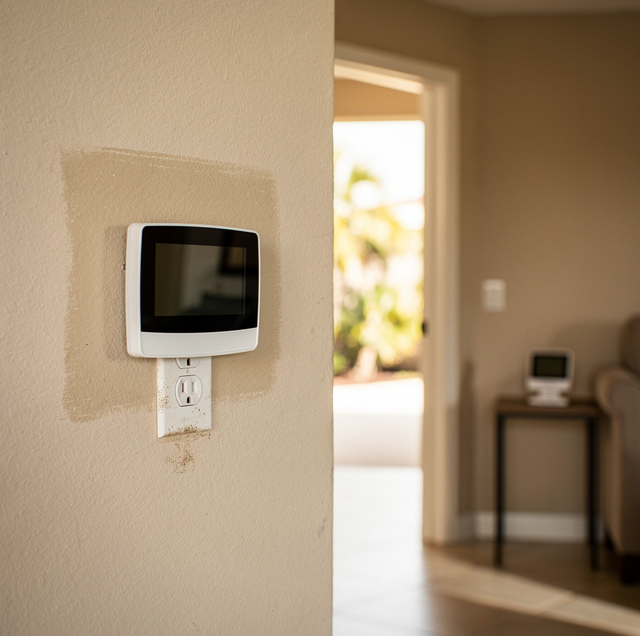
The thermostat in the hallway says one temperature. The little thermometer sitting on a shelf across the room says a different one. Nobody bumped a setting or touched the wiring, and the system is behaving exactly as it's supposed to: cycling on, holding, cycling off, as if the thermostat's number is the truth and the shelf thermometer is confused. It usually isn't. A thermostat doesn't measure a room; it measures the air touching one sensing element, mounted at one height, on one wall. The reading is a single measurement standing in for a whole room, the way a pressure gauge threaded into one point of a long pipe reports what's happening right there, not the average down the line. Most of the time the thermostat isn't wrong about what it's sensing. It's just not sensing the room you're standing in.
If you compare with a second thermometer, keep it away from any metal surface and out of the supply register's airstream. Either spot skews its reading fast enough to make an accurate thermostat look wrong, or hide one that's actually off.
Where the Thermostat Is Mounted Decides What It Actually Senses
Behind the faceplate is a sensing element, either a thermistor whose electrical resistance shifts with temperature or, in an older mechanical unit, a bimetallic strip that bends as two different metals expand at different rates. That element responds only to what's touching it or radiating onto it, and the mounting spot determines what that is. A wall that catches afternoon sun heats the plastic body and the wall surface behind it, not the air out in the middle of the room. A lamp or television running below or beside the thermostat throws off enough radiant heat to warm the case without warming the room.
A supply register aimed anywhere near it feeds the sensing element a stream of conditioned air, so the equipment shuts off as soon as that narrow stream hits setpoint, while the rest of the room is still behind. An exterior wall runs cooler or warmer than an interior one depending on the season, and a kitchen wall picks up cooking heat and steam a bedroom wall never sees. None of this means the thermostat is broken; it means the mounting location is reporting from a small patch of wall rather than the room as a whole. Noticing what's on the wall around it, and below it, is worth checking before assuming a malfunction.
A Draft Moving Through the Wall Behind It Skews the Reading
The thermostat's mounting plate covers a small hole drilled through the drywall for the low-voltage wiring bundle running back to the equipment. When that penetration isn't sealed around the wires, it leaves a path between the room and the wall cavity behind it, a cavity that often connects to an unconditioned space such as an attic chase, an exterior wall stud bay, or a crawlspace. Air moves through that gap whenever there's a temperature difference driving it, called the stack effect, or when wind pressure pushes on that side of the house. That moving air washes across the back of the sensing element, pulling the reading toward the wall cavity's temperature rather than the room's. This shows up in both directions: a cold draft in winter drags the reading down and can push the system to overheat the room, chasing a thermostat reading colder than reality, and a warm draft in summer does the reverse. A faint draft or a noticeably cooler spot right at the wall plate is a real clue.
The wiring penetration behind a thermostat's mounting plate is not a homeowner fix. Low-voltage thermostat wiring shares a cabinet with line-voltage power at the equipment end, so sealing or inspecting it is technician work.
The Sensing Element Itself Can Drift or Need Calibration
Even a thermostat mounted in a perfectly neutral spot, with no draft and no heat source nearby, can start reading off after enough time in service. A thermistor's resistance curve can shift slightly as the component ages; a bimetallic strip can lose some of its original spring tension after years of expanding and contracting through every cycle the house has run. Dust and lint that settle inside the housing over months can form a thin layer of insulation around the sensing element, slowing how quickly it responds to changes in room temperature rather than shifting the reading itself. On models that support it, a technician can apply a calibration adjustment that offsets the display back in line with a known-accurate reference reading. Not every model allows this, and it isn't something to attempt by guesswork, since an incorrect offset just trades one wrong number for another.
A Remote or Averaging Sensor Might Be Running the Show
Many communicating and multi-zone systems pair the wall thermostat with one or more remote sensors in other rooms, often where the household spends the most time or where the space runs hottest or coldest. On these systems, the number displayed on the wall unit isn't necessarily what the equipment uses to decide when to run. The system might be set to follow only the remote sensor, to average several sensors, or to switch which sensor counts based on time of day or on an occupancy schedule set up at install and never revisited. If the wall thermostat's reading doesn't match how the room feels, but a bedroom or living area does, that's a strong sign a sensor placed elsewhere is doing the actual work. Checking the app or on-screen menu for which sensor is active, and whether a schedule is switching between them, is worth a look before assuming the wall unit is at fault.
A System That's Running Nonstop but Not Catching Up Isn't a Sensor Problem
Sometimes the thermostat is reporting the room correctly, and the room simply hasn't reached setpoint yet. That's a different problem from a bad reading: here, the equipment runs long and steady without ever quite closing the gap. On a heat pump, part of what makes this feel like a reading error is that the heat pump's supply air runs noticeably cooler at the register than a gas furnace's, even while the system is heating correctly and the room is slowly climbing toward setpoint. How visible this gap looks on the display often comes down to a swing, or differential, tolerance the equipment is configured with by design, not a malfunction, and a real capacity shortfall on top of that tolerance can make the reading look wrong when the room is simply behind.
Stratification Separates the Reading from What You Feel in the Room
Warm air rises and cool air sinks, and in any room taller than a few feet, that creates a temperature gradient from floor to ceiling. A thermostat mounted at standard height on a mid-wall reads the air at that height, not the air at floor level where your feet are or near a ceiling fan in a room with a vaulted ceiling. Stratification shows up most in heating season, when warm supply air rises straight toward the ceiling in a large open room before it can mix downward, but it happens in cooling season too, when the coolest air pools low and the wall-height reading lags what the floor feels like. Open floor plans and high ceilings make the gap more noticeable simply because there's more vertical distance for the air to separate across.
What a Technician Actually Measures to Settle It
Sorting out which of these is actually happening starts with a calibrated reference thermometer held right beside the thermostat, not across the room, to confirm whether the display itself is off. From there, the check moves outward: what's mounted around and below the unit, whether a draft moves through the wall plate, whether the sensing element tests within range or needs calibration where the model supports it, which sensor the system is actually using if it's part of a remote or averaging setup, and a reading taken at more than one height to rule stratification in or out.
| What You Notice | What It Likely Points To | What Comes Next |
|---|---|---|
| The reading swings right after the sun hits that wall, or a lamp or TV sits nearby | Mounting location and what's around it | Rule out sun, lamps, and registers near that wall first |
| A faint draft or a cooler spot right at the wall plate | Air moving through the cavity behind the unit | Note it for a technician to check the wiring penetration |
| The gap has grown slowly over months with no clear cause | The sensing element is aging or needs calibration | A technician tests the element and calibrates it where the model allows |
| One room feels right, and another doesn't, and a companion sensor is installed | A remote or averaging sensor doing the actual work | Check the app or thermostat menu for which sensor is active |
| The system runs long and steady, but the room still isn't there | A capacity or delivery issue, not a sensing error | A technician checks output and duct delivery, not the sensor |
| The thermostat and the ceiling agree, but the floor feels different | Stratification between floor and ceiling | A technician measures at more than one height in the room |
A wrong-looking number is rarely a single cause. It's usually the mounting location, the wall behind it, the element itself, a sensor placed elsewhere, the equipment's own pace, or the room's layout, and a technician works through them in that order rather than guessing at one.
Frequently Asked Questions
On battery-powered units, yes. As batteries weaken, the voltage feeding the sensing circuit can sag before the low-battery icon ever appears on the display, which can show up as a sluggish or erratic reading rather than an obviously dead screen.
Most systems fall back to the thermostat's built-in sensor when a paired remote sensor drops offline, or its battery runs out, often displaying a low-battery or lost-sensor icon rather than making a silent handoff. Until that icon is noticed and addressed, the wall unit's own sensor is what's actually driving the equipment again, even if the app or schedule still shows a remote sensor assigned.
During a defrost cycle, the system briefly reverses to clear frost from the outdoor coil, and the indoor unit can blow distinctly cool air for several minutes while this occurs. It reads like the system is losing ground, but it's a scheduled operational step, not a fault.
Yes. Even with the penetration fully sealed, a wall backed by an unconditioned space conducts some of that space's temperature through the drywall, which can pull a thermostat mounted on that wall slightly out of sync with the rest of the house via conduction rather than air movement.
Some schedules include a ramping or recovery feature that starts the system early so the room hits setpoint exactly at the scheduled time, rather than starting right at the scheduled time and catching up afterward. During that lead-in window, the displayed gap between current and target is expected, not an error.
Yes. A bimetallic strip has to physically bend before it registers a change, which makes it respond more slowly to a fast-moving swing in room temperature than an electronic thermistor does, so a mechanical unit can lag a quickly changing room in a way a digital one won't.
Get a thermostat and sensor placement check — find out whether the number on the wall actually matches the air in the room. CMB Air serves Tampa and the Tampa Bay area. Call (813) 447-1443.
