
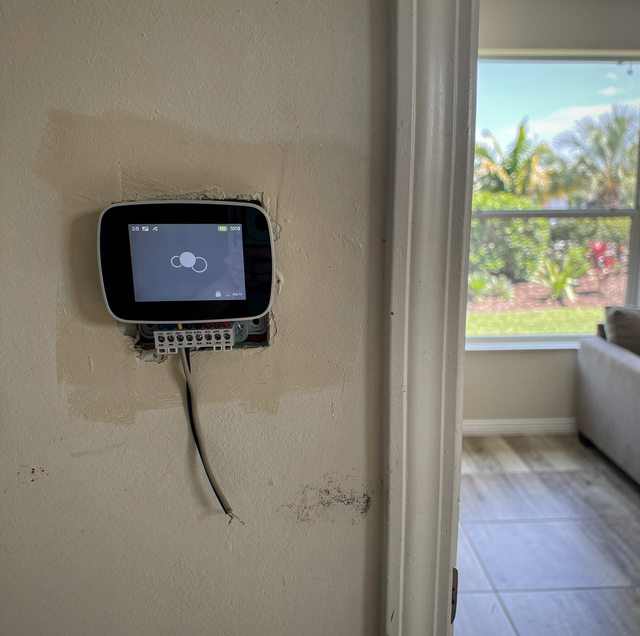
A programmable thermostat and a smart thermostat both sit on the same wall and control the same equipment, but they decide when to run it in different ways, and that difference matters more in a house where the AC runs nearly every day of the year than in one where cooling only kicks in for a short stretch each summer. The table below lines up the practical differences before you get into which one fits your system and your household.
| Feature | Programmable Thermostat | Smart Thermostat |
|---|---|---|
| Scheduling | Fixed time-of-day periods you set once, repeated daily or weekly | Same base scheduling; on learning models, adjustments based on how you change the setpoint by hand |
| Remote access | None; changes happen at the wall unit | App control from a phone, tied to a Wi-Fi connection |
| Learning or occupancy features | None | Some models add a motion sensor or phone-location detection to shift the setpoint when the house is empty |
| Humidity control | A basic fan switch: AUTO or ON | Some models add a dedicated humidity setpoint or dehumidify mode |
| Wiring needs (C-wire) | Battery-powered models need no C-wire | Models not built for batteries need continuous 24V power for the screen and radio, which calls for a common wire or a power-extender kit |
| Equipment compatibility | Handles single-stage cooling reliably; multi-stage and heat pump support varies by model | Same variation; app features do not change what the wiring can support |
| When Wi-Fi or power drops | Keeps running the stored schedule; nothing to reconnect | Falls back to its last schedule on the device, but loses remote access and alerts until the connection returns |
How Each One Controls the System
A programmable thermostat runs on a simple loop: it checks the room temperature against whatever setpoint is active for that block of the day, and it opens or closes the circuit to the equipment based on that comparison alone. Nothing about the schedule adjusts itself; it does exactly what was typed in until someone changes it. A smart thermostat runs the same basic loop underneath, but it layers decisions on top of it: an occupancy sensor or a phone's location can shift the active setpoint, and on models that build a schedule from your manual adjustments, the pattern you set by hand over the first week or two becomes the default going forward. A thermostat mounted where it can't accurately sense the room undermines both types equally, since a bad reading feeds an incorrect number into whichever logic is running on top of it.
Why Constant Cooling Changes Which Features Matter
A thermostat's scheduling and occupancy features earn their keep by shutting the system down or backing off the setpoint when nobody needs it running. That math works differently in a house where the AC is doing real work most hours of the day, because there is less idle time on the table to reclaim. What shifts in value instead is anything that tells you the system is behaving normally without you checking the wall unit in person: an app that shows the current setpoint and reading from wherever you are, an alert if the indoor temperature climbs well past the setpoint while nobody has adjusted anything, and the ability to place a sensor in the room that runs hot or cold instead of trusting one reading from the hallway. A programmable thermostat gives you none of that visibility; it just keeps running the schedule you gave it, correctly, with no way to check in remotely.
Humidity Control and Fan Settings
The fan switch on either type of thermostat has the same two positions at its core: AUTO, which limits blower operation to the compressor's own run time, and ON, which keeps the blower spinning around the clock regardless of whether the system is cooling. AUTO lets the coil drain between cycles, while ON keeps air moving across a wet coil and sends some of that water back into the house. Where a smart thermostat can add something a basic switch cannot is a separate humidity setpoint: instead of only responding to temperature, the system watches indoor humidity and calls for extra runtime to bring it down even after the room has already reached its temperature target. Year-round heat with a heavy moisture load makes that setpoint worth more in a house where the AC carries the load nearly every day than in one with a short cooling season, because a fan switch left on ON, or a humidity mode that goes unused, has more days each year to work against the house. In a home where cooling runs only part of the year, the same setting has fewer days to compound.
C-Wire and Power Needs
A basic programmable thermostat can run on two AA batteries because it only needs enough power to run a small display and check the temperature every few seconds; the actual switching happens at the equipment, not in the thermostat's own power draw. A smart thermostat's screen, its Wi-Fi radio, and its constant connection to the app draw power around the clock, so apart from models designed to run on batteries, it needs a steady supply. That is what the common wire, or C-wire, is for: it completes a continuous 24-volt circuit back to the transformer at the air handler, so the thermostat has steady power rather than stealing brief pulses from the same wires used to call for heating or cooling. Older systems installed before smart thermostats were common sometimes ran only four wires to the wall, with no C-wire included in the original run.
Adding a C-wire requires opening the air handler's control board, which shares its cabinet with line-voltage power; a technician must run that wire. Shut off power at the breaker before removing your thermostat's faceplate to look at the wiring.
Compatibility With Multi-Stage or Heat Pump Systems
A single-stage air conditioner only ever calls for one level of cooling: on or off. A multi-stage system, or a heat pump that also reverses to provide heat, sends more distinct signals to the thermostat, and the added stage or the reversing valve wants its own connection on the thermostat's base plate. Not every programmable model is built with that extra terminal, and not every smart model is either; the app, the touchscreen, and the Wi-Fi radio are separate from whether the base hardware was designed to talk to that particular equipment. Buying based on features alone, without checking what the thermostat is wired to control, is how a household ends up with a smart display that only ever runs the system's first stage.
With the breaker off, photograph the wires on your current base plate with the terminal letters showing before you shop. Letters such as O/B, Y2 or W2 tell you the new thermostat needs heat pump or second-stage support.
How Each Type Saves on Energy
A programmable thermostat saves energy by widening the setpoint during hours nobody needs the space conditioned, then narrowing it back before anyone returns. That saving comes from the schedule itself and from how closely the household sticks to it; a schedule that gets overridden by hand every evening reclaims little of what it was built to save.
A smart thermostat layers occupancy detection and geofencing onto the same setback idea. Instead of relying only on a fixed clock, it can widen the setpoint when a motion sensor detects no one home, switch to an auto-away mode when a phone crosses a set radius, and narrow the setpoint again on the way back. That closes the gap between what a fixed schedule assumes and where people are, but the saving still depends on the setback being wide enough and long enough to matter; a short absence recovers little either way.
How much a setback saves also depends on the equipment behind the thermostat. A single-stage, on-off system runs at full output whenever it runs, so it pulls a wide setback back down at full capacity. A variable-speed system favors long, low-output runs and ramps up gradually, so a deep setback takes longer to recover from, and a fairly steady setpoint suits that equipment better than a wide swing. A single-stage system can still make good use of one.
Which Household Each One Fits
A household on a steady daily routine, with a single-stage system and no interest in checking the thermostat from a phone, gets the full benefit of a programmable model without paying for features that would go unused: no app to set up, no Wi-Fi dependency, and one less device on the home network to keep updated. A household where people come and go at different times, where a room upstairs or a home office consistently runs warmer than the other rooms, or where being away for a stretch means wanting a way to check that the system is still running as expected, gets more practical use out of a smart thermostat's remote access, occupancy detection, and add-on sensors. Neither one changes what the equipment itself is capable of; both types depend on the same wiring and staging the system was installed with.
Frequently Asked Questions
Apps that support more than one phone can be set to switch the house to away only after every enrolled phone is outside the radius, and back when the first one returns. A phone that is not enrolled or has location access turned off is not counted, so the house can go to away while that person is still inside.
On models that store the schedule in non-volatile memory, no. The schedule sits on the circuit board, not in the batteries, so a dead battery resets the clock and display rather than erasing the programmed times; you only need to reset the current time once power returns.
Some existing cable bundles carry an unused spare conductor behind the wall, which a technician can connect as the C-wire at both ends, so the thermostat gets steady power without a new wire run.
On some models, yes, through a dedicated accessory terminal or relay that lets the dehumidifier call for a cycle on its own schedule, independent of whether the compressor is actively cooling at that moment.
Not always. Beyond landing the right wires on the right terminals, some multi-stage thermostats also require a stage-2 differential set during setup, telling the system how far the temperature must drift before the second stage kicks in; skip that setting on those models, and the thermostat may never call for it.
On some variable-speed air handlers, a dehumidify terminal on the thermostat slows the blower during a humid call. Hence, the coil stays colder longer and pulls more water out of the air, without changing the temperature setpoint at all.
Schedule a thermostat wiring and staging check — a technician confirms your system's C-wire support and multi-stage compatibility so you buy the right model the first time. CMB Air serves Tampa and the Tampa Bay area. Call (813) 447-1443.