
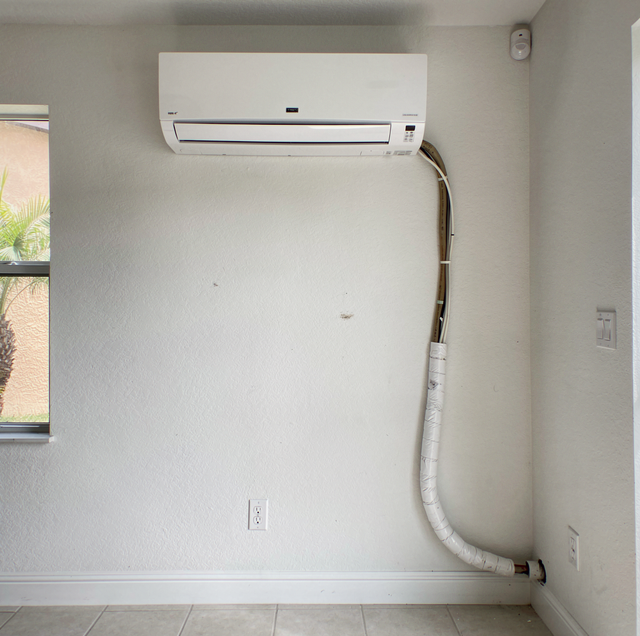
A mini-split head mounted high on an interior wall hides most of what it's doing, but inside that plastic housing sits a long, shallow drain trough running the width of the head, catching water one drop at a time. Every drop that lands there has to leave the same way it arrived: through a path built into the unit and the wall behind it. Whether that path is a length of tubing running downhill to the outside, or a small pump lifting the water somewhere gravity can't reach on its own, depends entirely on what the wall and the room around that head allow.
The Pan Inside the Head Has No Room to Spare
Central air handles condensate with a drain pan set under a coil that spans most of the width of a large air handler cabinet, feeding a rigid pipe that carries the water outside. The evaporator coil inside a wall-mounted head is a folded strip of finned tubing that still runs most of the width of the unit, often two to three feet across on a typical head, and the pan beneath it is a long, shallow trough sized to match: built to catch water as fast as the coil produces it rather than to store much of a reserve. That pan has one job: to funnel condensate to a single outlet, and it has almost no capacity to buffer a slow drain. If water leaves that pan more slowly than it arrives, the pan fills and overflows within hours, not days.
From the Pan, a Thin Line Carries the Water Downhill
Water leaves the pan through a length of soft tubing, usually bundled and taped alongside the refrigerant lines and control wiring inside the same line set that connects the head to the outdoor compressor. That bundle passes through a wall penetration sized to the line set, and from there the condensate line has exactly one requirement: it has to fall, continuously, from the pan to wherever it ends. Not level, not flat for a few feet and then downhill, but falling the entire distance. A dip anywhere along that run holds a puddle of standing water, and a puddle sitting in a thin tube is exactly wide enough to seal the tube shut with an air lock, which stops everything behind it from draining at all.
That single requirement is why the same job that's simple on paper gets complicated fast in a real house. A head mounted on an interior wall, chosen because that's where the ductwork or the layout made sense, may not have a straight run to an exterior wall at all. A run has to snake along a joist bay, drop through a closet, or cross above a doorway, and every turn is a chance to lose the fall it needs.
Where the Line Ends Decides Whether It Was Ever Going to Work
A condensate line that runs to an exterior wall and exits a few inches above grade, tied into the same wall penetration as the refrigerant lines, is the simplest version of this system: gravity does the entire job on its own, with no pump anywhere in the line. The line can also tie into an existing household drain, a floor drain, or a utility sink, provided the connection point is low enough that the line still falls the full length there.
The trouble starts when neither option exists at the head's actual location. A head mounted on an interior wall in a room with no nearby exterior wall or drain forces the condensate line to run horizontally for most of its length before it has anywhere to go. A line that has to cross a room before it can fall anywhere sits flat instead of sloped, and a flat line doesn't drain. It collects.
The Point Where Gravity Stops Being an Option
Gravity fails for a short list of reasons, and they all come down to distance and geometry rather than anything wrong with the equipment. A long horizontal run between the head and the nearest exit point consumes the available vertical drop before the line ever reaches open air. A head mounted low relative to where the line has to exit, or on a wall where the only path out runs uphill for even a short stretch, removes the option entirely. And a head on a lower floor or in a basement, where the only drain or exit point sits above the head's outlet, asks the water to climb, which gravity cannot do at any distance.
A head that runs most of the year in muggy weather pulls far more water per day than the same head in a house with dry air or a short cooling season, and it is in the humid house that a narrow drain line clogs. So the technician sizing the pump and the line for that room plans for the wettest weeks rather than an average one.
Ask where the pump's discharge line will end before the head goes up. The pump is chosen based on how high and how far it has to push water to that point, so a different exit point can require a different pump.
How the Pump Takes Over From Gravity
A condensate pump is a small sealed unit, often tucked behind or beneath the indoor head, that holds a reservoir far smaller than the drain pan itself. As the pan feeds water into that reservoir, a float rises with it, and once the float reaches a set point, the pump switches on and pushes the accumulated water up and out through a narrow discharge line, sometimes lifting it several feet before it reaches a point where gravity can take over the rest of the trip. It isn't running constantly. It cycles on for a few seconds at a time, clearing the reservoir each time before the float trips again.
The discharge line coming off the pump runs its own short path, separate from the condensate line it replaces, and installers often route it inside the same line-set cover that already hides the refrigerant tubing rather than adding a second visible line down the wall. The float does more than start the pump: at a second, higher point it also cuts power to the indoor unit rather than let the reservoir overflow into the wall.
A pump that hums without emptying, or water at the base of the wall under the head, can mean water is reaching wiring inside the wall. Switch the unit off at the thermostat and have a technician open the housing.
Signs the Drain Path Isn't Keeping Up
A few symptoms point straight back to the condensate path rather than to the refrigerant side of the system. A damp patch or a small stain on the wall or ceiling below or beside the head, appearing only after the unit has been running for a while, usually traces back to a line that's dripping somewhere along its run rather than carrying water all the way out. And a faint gurgling or clicking sound from inside or behind the head, timed to when the system has been cooling for a stretch, is often the pump itself cycling, which is normal in isolation but worth mentioning to a technician if it starts running far more often than it used to. None of these call for opening the unit or tracing the line yourself; they're reasons to get a technician to look at the actual path the water takes.
Frequently Asked Questions
It varies with humidity and runtime, but a single indoor head cooling a room hard in a humid stretch can pull several gallons of water out of the air over a full day, sometimes more than five. That volume is what makes a marginal drain path fail during the heaviest use rather than during a mild week.
Most mini-split condensate lines run through soft tubing around five-eighths of an inch in diameter, narrower than the roughly three-quarter-inch PVC pipe a central air system uses to carry away the same water.
No. A condensate pump typically draws power from the indoor head's wiring or a nearby standard outlet rather than a separate circuit, and it plugs into or is wired to a circuit the technician confirms can carry the load. It isn't a stand-alone appliance a homeowner plugs in and manages on its own.
Small. Most units hold only a few ounces of water before the float triggers a pump cycle, which is why the pump runs in short, frequent bursts rather than long stretches. The discharge line coming off that reservoir has to end at an open air gap or a trapped connection rather than tie directly into a closed drain, so water on the other end of that drain can't siphon back into the pump.
There's no fixed interval to point to, but it is a wear part: the float and the small motor inside it typically give out well before the head's coil or the outdoor compressor do. That's why a technician checks the pump on its own at a routine service visit instead of assuming it's fine just because the coil and compressor still are.
A small check valve in the discharge line. It closes after each pump cycle so the water already pushed out cannot flow back down into the reservoir and force the pump to work the same water twice. A technician checks that valve during a tune-up, since a stuck one can leave the pump running far more than it needs to.
Trace your mini-split's condensate path with a technician — pan, line, and the point where a pump has to take over. CMB Air serves Tampa and the Tampa Bay area. Call (813) 447-1443.