
AC Blowing Warm Air but Still Running? What to Check
Quick Answer: Warm air from a running AC almost always means the system is still moving air but no longer moving heat out of your home. Start with the homeowner-safe checks: thermostat mode, a clogged filter, a tripped breaker on the outdoor unit, an iced-over coil, and debris packed around the condenser. If those are clear, the fault is usually refrigerant, the compressor, or a control part, which needs a technician.
An air conditioner that runs but never cools is one of the more confusing failures a homeowner runs into. The thermostat clicks, the indoor fan whooshes, air moves through the vents, and by every sign the system is "on." Yet the room stays warm and the air coming out feels no cooler than the hallway. The machine is working; the cooling is not.
That gap between "running" and "cooling" is the whole diagnosis. Some causes you can find and fix in a few minutes with nothing but your eyes and a flashlight. Others sit inside sealed refrigerant lines or electrical parts that hold a dangerous charge, and those belong to a licensed technician. This walks through both, in the order a careful person should check them, so you know when to reach for a filter and when to reach for the phone.
How Cooling Actually Happens
An air conditioner does not make cold. It moves heat. Warm indoor air is pulled across a cold indoor coil (the evaporator), where liquid refrigerant absorbs the heat and boils into a gas. That gas travels outside to the condenser coil, where a compressor squeezes it, and a fan blows outdoor air across it to dump the collected heat into the yard. The now-cooled refrigerant loops back inside to grab more heat. Two coils, one pump, one continuous relay race carrying heat from your living room to your lawn.
The indoor blower and the outdoor heat-rejection side are driven by separate motors and separate power feeds. That separation is why warm air is so common: if the compressor or condenser stops but the indoor blower keeps spinning, the fan cheerfully pushes household-temperature air through your ducts. Nothing is cooling it on the way past. A pinched garden hose is a fair picture of the same idea: the pump at the spigot can hum all day, but if the flow is choked somewhere downstream, nothing useful comes out the nozzle. The blower is your nozzle. The compressor is the pump that has to keep the loop flowing.
Knowing that, the checklist below is really one question asked five ways: is the heat actually leaving your house, or is the fan just moving warm air in a circle?
What You Can Safely Check Yourself
These require no tools beyond a flashlight, and none of them involve opening an electrical panel or touching a sealed refrigerant line.
Thermostat Mode and Fan Setting: Start at the wall. A thermostat bumped to HEAT, or nudged above room temperature, will run the blower while calling for no cooling at all. Confirm it reads COOL and the target is set several degrees below the current room temperature. Then check the fan switch. Set to ON, the blower runs constantly even between cooling cycles, so you feel neutral, room-temperature air during the off stretches and mistake it for a failure. Switch the fan to AUTO so it only runs when the system is actively cooling. If a programmable or smart thermostat recently lost power or updated, its schedule may have reverted, so recheck the setpoint too.
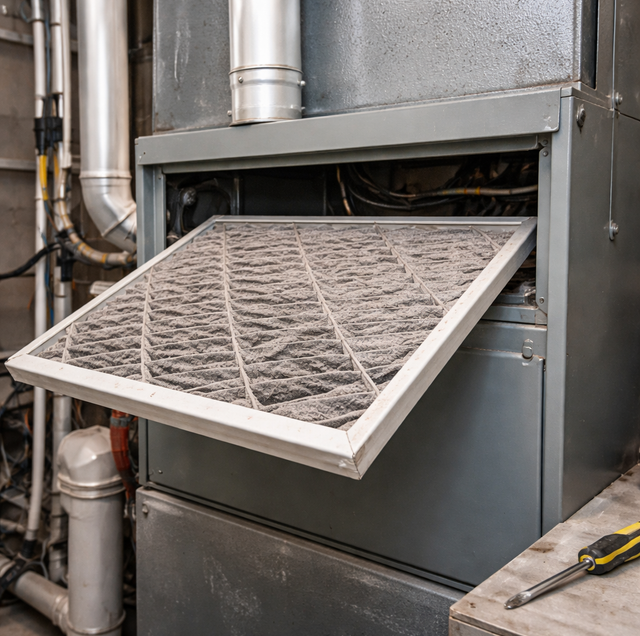
A Clogged Air Filter: A filter thick with dust starves the indoor coil of airflow. Less air across the coil means the little cooling that happens gets trapped, the coil runs colder and colder, and output at the vents drops. A filter should let light pass through it when you hold it up; if it looks like gray felt, replace it. This is the single most common cause of weak, warm airflow and the easiest to rule out.
Hold the air filter up to a light. A healthy filter still lets light pass through, while one that looks like gray felt is choking airflow and should be replaced.
A Tripped Breaker to the Outdoor Unit: The outdoor condenser usually sits on its own breaker, separate from the indoor air handler. If that breaker trips, the compressor and outdoor fan go dark while the indoor blower, on its own circuit, keeps running. The result is textbook: air moves, but it is never cooled. Open your electrical panel, look for a breaker flipped to the middle or OFF position, and reset it once, firmly to OFF then back to ON. If it trips again within minutes, stop. A breaker that will not hold is protecting you from a real fault downstream, and forcing it repeatedly is how a nuisance turns into damage.
An Iced-Over Coil: It sounds backward, but a frozen coil blows warm air. When ice sheaths the indoor evaporator, it acts like a blanket and blocks heat transfer entirely; the fan pushes air past a wall of frost and delivers it uncooled. Signs include visible ice on the copper lines near the indoor unit or water pooling as it melts. The homeowner fix is to switch the system to OFF (not just up a few degrees) and let it thaw fully, often several hours, running the fan-only setting to speed it along. Ice forms from restricted airflow or low refrigerant, so if it refreezes after thawing, the underlying cause is still there and needs a tech.
Debris Packed Around the Condenser: Walk out to the outdoor unit. It rejects heat by pulling air through its coil fins, and it cannot do that buried in grass clippings, cottonwood fluff, leaves, or a shrub that grew in against the cabinet. Clear a couple of feet of open space on all sides and gently brush away anything matting the fins. A smothered condenser cannot dump heat, so the refrigerant returns indoors still warm and your vents feel it. This one earns its place year-round: seedpods and pollen clog fins in spring, grass in summer, leaves in fall.
What Needs a Technician
If everything above checks out and the air is still warm, the fault has moved past what is safe to touch. The parts below carry sealed refrigerant under pressure or store an electrical charge that can injure you even with the power off. This is where a licensed pro takes over.
Low Refrigerant or a Leak: Refrigerant is not fuel, and it is not consumed; a system that is low has a leak. As the charge drops, the coil cannot absorb enough heat, output warms, and ice often forms on the lines. Recharging without finding and sealing the leak just vents the new refrigerant into the air within weeks. Handling refrigerant is EPA-licensed work, both because the chemistry is regulated and because the lines are pressurized. Leave it to a technician who can locate the leak, repair it, and recharge to the manufacturer's spec.
A Failed Compressor or Capacitor: The compressor is the pump that keeps the whole loop moving. When it fails, or when the run capacitor that gives its motor a starting jolt dies, the outdoor unit may hum, click, or sit silent while the indoor fan runs on unbothered. A capacitor stores a charge that can shock you badly even after the disconnect is pulled, so this is not a part to inspect yourself. A technician confirms it with a meter before touching anything.
A run capacitor stores an electrical charge that can shock you badly even after the outdoor disconnect is pulled, so it is not a part to inspect yourself. The refrigerant lines are sealed and under pressure as well. Leave the compressor, capacitor, and refrigerant work to a licensed technician who can confirm the fault with a meter first.
A Bad Contactor: The contactor is the relay that switches high-voltage power to the compressor and outdoor fan when the thermostat calls for cooling. Its contacts can pit, corrode, or weld from years of arcing. When it fails to close, the outdoor unit never energizes even though the thermostat is calling correctly, and the indoor blower keeps delivering warm air. It is a common, inexpensive failure a tech diagnoses quickly.
A Reversing-Valve Fault on a Heat Pump: If your system is a heat pump rather than a straight AC, one extra part can cause exactly this symptom. The reversing valve is what lets a heat pump run "backward" to heat in winter and forward to cool in summer. If it sticks or its control solenoid fails, the unit can stay stuck in heating mode and blow warm air on a cooling call. Diagnosing it means reading temperatures and pressures on both sides of the valve, which is technician territory.
How a Technician Pins It Down
A good tech does not guess. Two measurements usually tell the story fast. The first is the temperature split: the difference between the air pulled into the return and the air coming off the supply register. A healthy cooling system typically drops the air somewhere in the high teens to low 20s of degrees Fahrenheit across the coil. A split near zero confirms the air is passing through without being cooled, which points squarely at the heat-rejection side. The second is refrigerant pressure. Gauges on the high and low sides reveal an undercharge, a restriction, or a compressor that is not pumping, each of which reads as a distinct pressure signature. Between those two numbers, a technician separates an airflow problem from a refrigerant problem from a mechanical one without pulling the system apart on a hunch.
Frequently Asked Questions
This pattern usually means the system is marginal, not fully broken, and the extra outdoor heat load in the afternoon pushes it past what it can handle. A slightly low refrigerant charge or a partly dirty condenser can cool adequately when it is cooler out, then lose ground as ambient temperature climbs and the head pressure rises. The time-of-day clue is worth telling your technician; a fault that tracks the outdoor temperature points toward the condenser or charge rather than the thermostat or filter.
Yes. If the thermostat's low-voltage wiring, especially the common (C) wire, is loose or its batteries are failing, it can send the fan signal reliably but drop the compressor signal intermittently. The display still shows "cooling" because the thermostat believes it sent the command. A tech confirms this by testing for 24 volts on the Y terminal at the air handler while the thermostat calls for cooling; no voltage there with a valid call points back to the thermostat or its wiring, not the outdoor unit.
Running fan-only circulates air and helps a frozen coil thaw, but it does not cool, and on a very humid indoor day it can actually make the room feel clammier because the moving air is not being dehumidified across a working coil. If the coil is iced, fan-only with cooling switched off is the right move to thaw it. If nothing is frozen and you just want airflow, it is harmless, but keep expectations low. It moves room-temperature air, nothing more.
It can, once the fins are badly enough clogged. A condenser coil matted with dirt on the inside of the fins (not just surface debris you can see) raises head pressure and can trip the compressor's internal overload, which shuts the compressor off on a thermal cutout while the fan keeps spinning. Nothing is broken in the replace-a-part sense, but the unit cools intermittently until the coil is professionally washed. This is why a seasonal coil cleaning prevents more failures than most homeowners realize.
An oversized unit rarely blows outright warm, but a chronically undersized or aging one can. A system near the end of its service life loses cooling capacity as its compressor wears, so it keeps up on mild days and falls behind on peak ones, delivering air that feels only slightly cool. If your equipment is well past a decade old and this is a new, worsening pattern, ask your technician to measure actual delivered capacity rather than assuming a single part is at fault.
A working system should deliver noticeably cooler air within a few minutes, but many units have a built-in compressor time-delay of three to five minutes that prevents the compressor from restarting too soon after it shuts off. This protects the motor from a hard restart against high pressure. So a short wait after a cycle is normal; a wait that stretches past five minutes with the outdoor unit silent is not, and it points to a control or compressor issue rather than the delay doing its job.
Book a cooling diagnostic today — get a straight answer on why your vents are warm and what it takes to fix it. CMB Air serves Tampa and the Tampa Bay area. Call (813) 447-1443.
